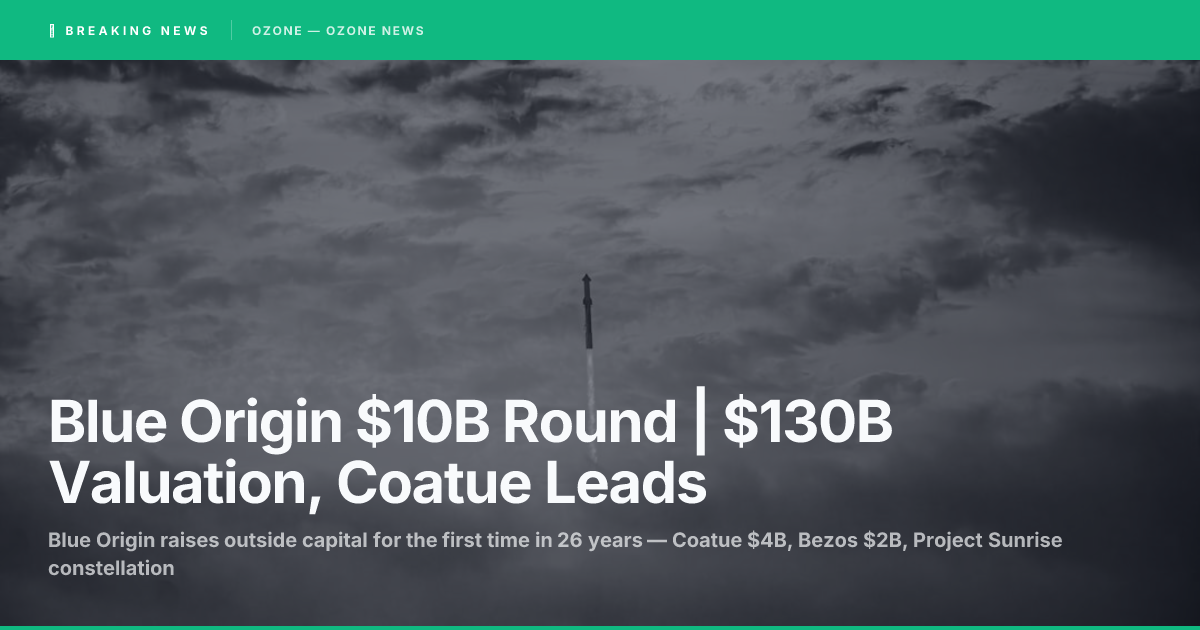
NEW YORK. For twenty-six years, Blue Origin operated on a simple funding model: Jeff Bezos sold roughly $1 billion in Amazon stock each year and directed the proceeds into his aerospace company. No outside investors. No quarterly earnings calls. No pressure from institutional shareholders with quarterly return expectations. On July 8, 2026, that model ended. Details reported by The New York Times DealBook revealed that Blue Origin is seeking $10 billion in its first-ever external funding round, at a pre-money valuation of $130 billion. The company that Bezos founded in a garage in Kent, Washington, is now building the financial architecture of a major public corporation.
The Round Structure | Coatue, Bezos, and $4B Still to Fill
The round has a clear hierarchy. Coatue Management, the tech-focused asset management firm led by Philippe Laffont with approximately $60 billion in assets under management, is anchoring the deal with a $4 billion commitment. Coatue has a track record of backing technology companies at critical scale inflection points, with prior positions in SpaceX, Snap, and Lyft. The firm's lead role signals institutional conviction in Blue Origin at this valuation level. Alongside Coatue, Jeff Bezos himself is contributing an additional $2 billion as part of the structured round, maintaining his personal financial stake as the company opens to external capital for the first time. The remaining $4 billion is being actively marketed to top-tier institutional investors, sovereign wealth funds, and private equity offices. Early reports indicate significant inbound interest, with the round expected to be oversubscribed.
The SpaceX Effect | How a $1.75 Trillion IPO Changed Everything
The timing is not coincidental. SpaceX completed its IPO last month at a staggering $1.75 trillion valuation, raising $86 billion in the process. The public listing demonstrated that equity markets will assign extraordinary valuations to commercial space infrastructure companies with demonstrated operational capability and long-term government contract pipelines. For Blue Origin, this created both a benchmark and a pressure point. Remaining a wholly private, single-backer company while a competitor commanded a public market cap larger than most national economies was no longer strategically tenable. The $130 billion pre-money valuation on the Blue Origin round implicitly positions the company as a fraction of SpaceX's current market value, acknowledging the operational gap while asserting a premium over earlier, smaller private valuations.
The competitive dynamic extends beyond valuation optics. SpaceX currently executes dozens of launches per year across Falcon 9, Falcon Heavy, and Starship, generating substantial commercial revenue that funds continuous R&D. Blue Origin's launch cadence remains significantly lower, making it more dependent on large government contract tranches like the Blue Moon lunar lander for NASA Artemis and national security launch contracts for the U.S. Space Force. The $10 billion round gives Blue Origin runway to close that operational gap without solely relying on Bezos personal liquidity.
New Glenn Recovery | The Immediate Capital Priority
The most pressing near-term use of the incoming capital is stabilizing the New Glenn program. Blue Origin heavy-lift rocket suffered a major setback in May 2026 when a booster exploded during a static fire test at Launch Complex 36 on Cape Canaveral, damaging the pad infrastructure and halting the launch schedule. New Glenn is central to Blue Origin's commercial and government launch strategy. It is the vehicle contracted for both commercial rideshare missions and the national security payloads that form the backbone of the company's government revenue. Rebuilding the pad, completing root-cause analysis on the BE-4 engine anomaly, and recertifying the vehicle for return to flight are immediate priorities that require substantial capital outlay before any revenue can resume from that vehicle.
For detailed coverage of the May 2026 incident and the pad rebuild, see OzoneNews reporting on the New Glenn pad rebuild at LC-36 and the New Glenn explosion at Cape Canaveral.
Project Sunrise | 51,600 Satellites for Orbital AI
The longer-horizon capital allocation is Project Sunrise, Blue Origin proposed constellation of up to 51,600 satellites designed not for telecommunications but for hosting orbital AI data centers. The concept addresses a fundamental bottleneck in the global AI infrastructure build-out: cooling and energy. Large-scale AI training clusters on Earth consume enormous quantities of electricity and require sophisticated cooling systems. Space-based processing sidesteps terrestrial energy grid constraints, access to dedicated solar power, and eliminates the cooling problem entirely using the thermal radiative environment of orbit. Jeff Bezos previewed the orbital data center concept publicly at the VivaTech conference in Paris in June 2026, framing it as a long-term reorientation of Blue Origin commercial strategy beyond launch services.
Analysts note that the commercial viability timeline for orbital AI data centers is measured in decades rather than years. Building 51,600 satellites requires manufacturing and launch capacity that would take years to ramp, and the economics of transmitting processed AI results between orbital and ground systems at commercially viable latency and bandwidth remain unproven at scale. Project Sunrise is a strategic positioning bet rather than an imminent revenue source, but it gives Blue Origin a narrative that SpaceX Starlink does not: a direct play on the AI infrastructure investment cycle that has dominated technology capital allocation since 2024.
For more on orbital data center developments and commercial space finance, see OzoneNews coverage of Bezos orbital data center announcement at VivaTech and the SpaceX IPO valuation analysis. Related space business coverage includes LINK spacecraft mission status on the Swift Observatory rescue.