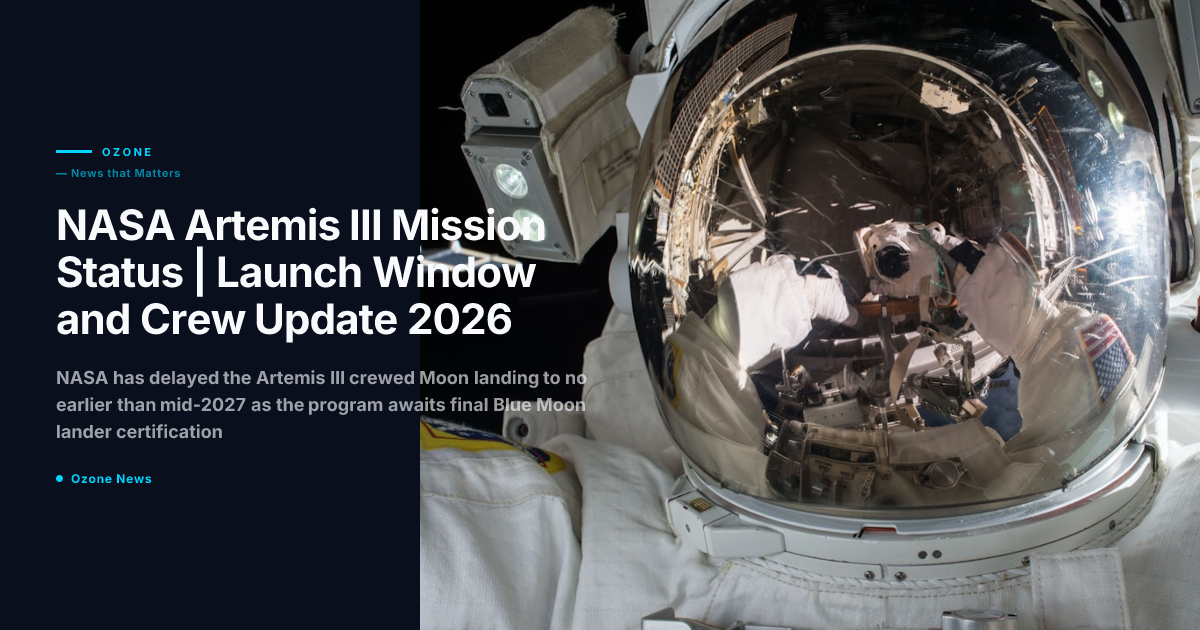
NASA confirmed in its latest program status report that Artemis III, the first crewed Moon landing since Apollo 17 in 1972, will not launch before mid-2027. Two hardware programs are on the critical path: SpaceX's Human Landing System (HLS), based on a modified Starship, must complete two uncrewed demonstration flights, and the xEMU spacesuits built by Axiom Space must pass full vacuum qualification testing.
Artemis III Launch Window | Current NASA Estimate
NASA's Exploration Systems Development Mission Directorate placed the current target at "no earlier than mid-2027" in its May 2026 report to Congress. The previous target was late 2026. The agency cited two slipped milestones: SpaceX HLS has completed one uncrewed lunar-vicinity demonstration but requires a second before crew certification, and Axiom Space delivered the first AxEMU prototype to NASA's Johnson Space Center in March 2026 for pressurized fit checks.
The delay does not affect Artemis II, which remains on track for a crewed lunar flyby in April 2026. That mission will carry Commander Reid Wiseman, Pilot Victor Glover, Mission Specialist Christina Koch, and Canadian Space Agency astronaut Jeremy Hansen on a ten-day free-return trajectory around the Moon without landing.
SpaceX Starship HLS | Where Certification Stands
SpaceX completed the Starship Flight 9 test in May 2026, achieving booster catch on the mechazilla arms for the second consecutive time. However, the HLS variant adds a lunar-optimized propellant depot interface, extended landing legs, and a crew airlock not present on the current Starship design. NASA's certification requirements for HLS include a full-duration engine test in lunar vacuum simulation conditions, which SpaceX is targeting at its Boca Chica facility in late 2026.
An independent review board convened by NASA's Aerospace Safety Advisory Panel noted in April 2026 that the "technical maturity of HLS remains lower than desired at this mission phase" but stopped short of recommending a further delay.
Axiom Space xEMU Suits | March 2026 Prototype Delivery
Axiom Space delivered two AxEMU prototype suits to NASA Johnson Space Center on March 14, 2026. Engineers are conducting pressurized mobility tests in the Neutral Buoyancy Lab to validate shoulder and hip joint range-of-motion for lunar surface geology tasks. Full vacuum qualification in NASA's Space Environment Simulation Lab is scheduled for Q3 2026. A third suit, designated as the backup unit, is in fabrication at Axiom's Houston facility.
The AxEMU suits represent a significant improvement over the Apollo-era A7L: they are designed for a 6-hour EVA at the lunar south pole, operate at temperatures as low as minus 280 degrees Fahrenheit, and include a heads-up display with helmet-mounted lighting for the permanently shadowed regions where water ice deposits have been confirmed by LCROSS and LRO data.
Lunar South Pole Landing Sites | Thirteen Candidates Remain
NASA's Human Exploration Research Analog team has narrowed the Artemis III landing zone to 13 candidate sites within six degrees of the lunar south pole, all identified from Lunar Reconnaissance Orbiter terrain data. The Haworth Crater rim, Nobile Crater rim, and Shackleton-de Gerlache Ridge remain the top three candidates based on solar illumination duration, terrain slope, and proximity to confirmed water ice deposits.
The final landing site selection requires inputs from the completed HLS terrain-relative navigation system test, which has not yet occurred. NASA expects to designate a primary site and two alternates 12 months before the mission launch date.
Why This Matters
Artemis III is not just a return to the Moon. It will be the first time a woman and the first time a person of color walk on the lunar surface. The science objectives include drilling into permanently shadowed regolith to collect water ice samples, deploying a seismometer network, and testing in-situ resource utilization equipment that will feed directly into the logistics chain for the proposed Lunar Gateway station. Delays are frustrating, but NASA leadership has consistently said that crew safety and hardware certification take precedence over schedule.
Frequently Asked Questions
- When will Artemis III launch? NASA's current estimate is no earlier than mid-2027, pending SpaceX HLS certification and Axiom Space xEMU suit qualification.
- Who will crew Artemis III? NASA has not announced the Artemis III crew. The Artemis II crew (Wiseman, Glover, Koch, Hansen) is confirmed for the lunar flyby precursor mission.
- Where will Artemis III land? The south pole region, within six degrees of the pole. Thirteen candidate sites remain. The final site has not been designated.
- What is SpaceX's role? SpaceX provides the Human Landing System (HLS), a modified Starship that will transport astronauts from Gateway orbit to the lunar surface and back.