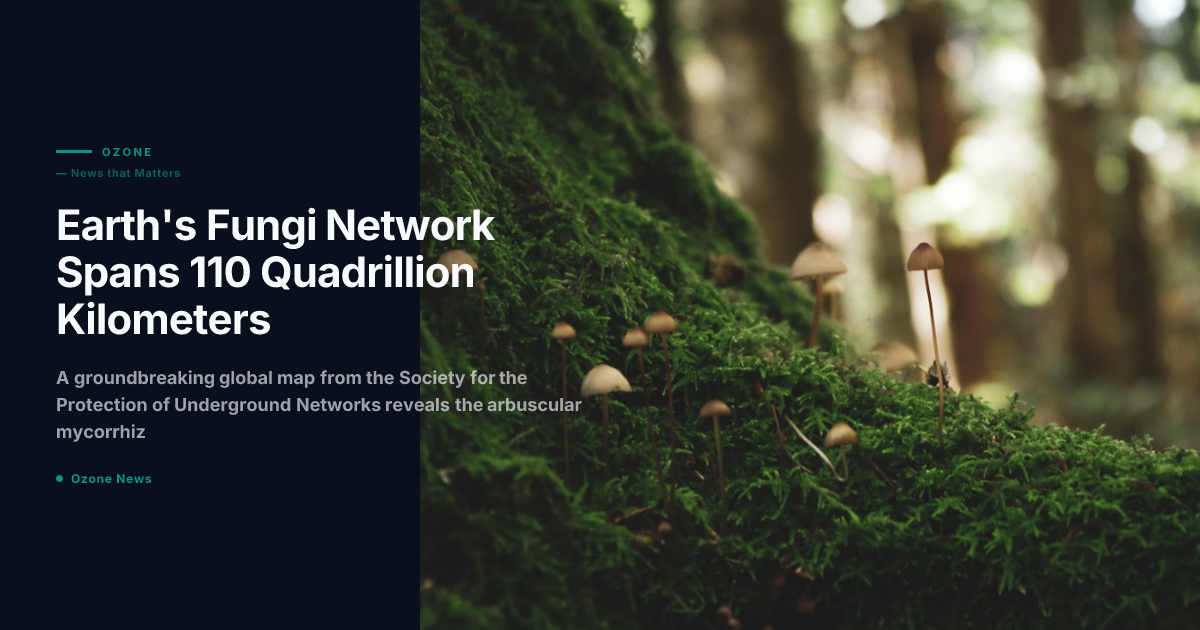
The narrative of Earth's biosphere has long focused on what is visible to the naked eye: the sprawling rain forests, the open savannas, and the creatures roaming across them. A groundbreaking global study has fundamentally shifted that understanding by mapping the true, cosmic scale of Earth's hidden support system. Using machine learning models trained on vast global soil datasets, researchers from SPUN generated the first comprehensive global map of arbuscular mycorrhizal (AM) fungi, revealing an underground web that measures an incredible 110 quadrillion kilometers in total length.
The Cosmic Scale of the Underworld | How Far Does It Reach?
To grasp the density of this subterranean grid, researchers mapped fungal concentrations across terrestrial ecoregions worldwide. The network acts as a literal glue for global soils, binding nutrients and water in a microscopic mesh that exists almost everywhere beneath our feet.
Beyond the planetary total, the microscopic density of this network is equally staggering. A single teaspoon of healthy, undisturbed topsoil can harbor up to 10 meters, or 32 feet, of interconnected fungal threads. That density underpins an entire planetary system of nutrient transport, water retention, and carbon storage that humans are only beginning to comprehend at its true scale.
The Ultimate Symbiotic Infrastructure | How the Trade Works
Arbuscular mycorrhizal networks are not passive underground structures. They operate as a sophisticated resource-trading system that sustains more than 70 percent of all land-based plant species. Fungi wrap around and penetrate the root structures of plants, extending the plant's effective foraging area by up to 100 times. This ancient partnership forms the basis of global nutrient cycling, and the terms of trade have remained largely unchanged for hundreds of millions of years.
The Threat to Earth's Secret Network | What Humans Are Destroying
Despite the critical role this fungal infrastructure plays in climate regulation and plant survival, the global mapping project revealed severe decline in areas impacted by intensive human activity. Fungal network densities in cultivated croplands measure 47.3 percent lower than in undisturbed, wild ecosystems. Modern industrial agriculture disrupts this symbiosis through two primary mechanisms.
First, deep mechanical plowing physically fragments the continuous network of fungal hyphae. This disruption forces the ecosystem to repeatedly expend energy rebuilding pathways rather than channeling resources into plant growth. The damage is not superficial. A hyphae network severed by a plow blade must regrow from scratch, and each growing season of tillage resets the clock on recovery before the network can reach full operational density.
Second, the heavy application of synthetic fertilizers and chemical fungicides fundamentally alters plant behavior. When crops are saturated with easily accessible artificial nutrients, they stop allocating carbon down to their roots. The fungal network is starved of the photosynthetic carbon it depends on, causing the symbiotic relationship to break down entirely. The result is a cycle of increasing chemical dependency: weaker soil networks require more synthetic inputs, which further weaken the networks.
The Path Toward Preservation | What Policymakers Are Being Asked to Do
The SPUN global map arrives at a critical turning point for international environmental policy. SPUN and its research partners plan to present this comprehensive dataset at the upcoming United Nations desertification summit, with the goal of establishing actionable soil health benchmarks. The recommendations center on three transitions: a shift toward low-till or no-till agricultural practices, wider adoption of cover cropping to maintain root systems year-round, and a reduction of synthetic chemical dependencies that sever the plant-fungi exchange.
For a broader look at how underground ecosystems connect to surface biodiversity, see our coverage of sea star recovery along the West Coast and all science coverage on OzoneNews. Related climate reporting includes our analysis of ozone layer recovery data for 2026 and the Keeling Curve CO2 peak at Mauna Loa.
By understanding the true scale of the world beneath our feet, conservation efforts can expand beyond protecting what is visible on the surface, ensuring the preservation of the vital microscopic networks that keep our planet alive.