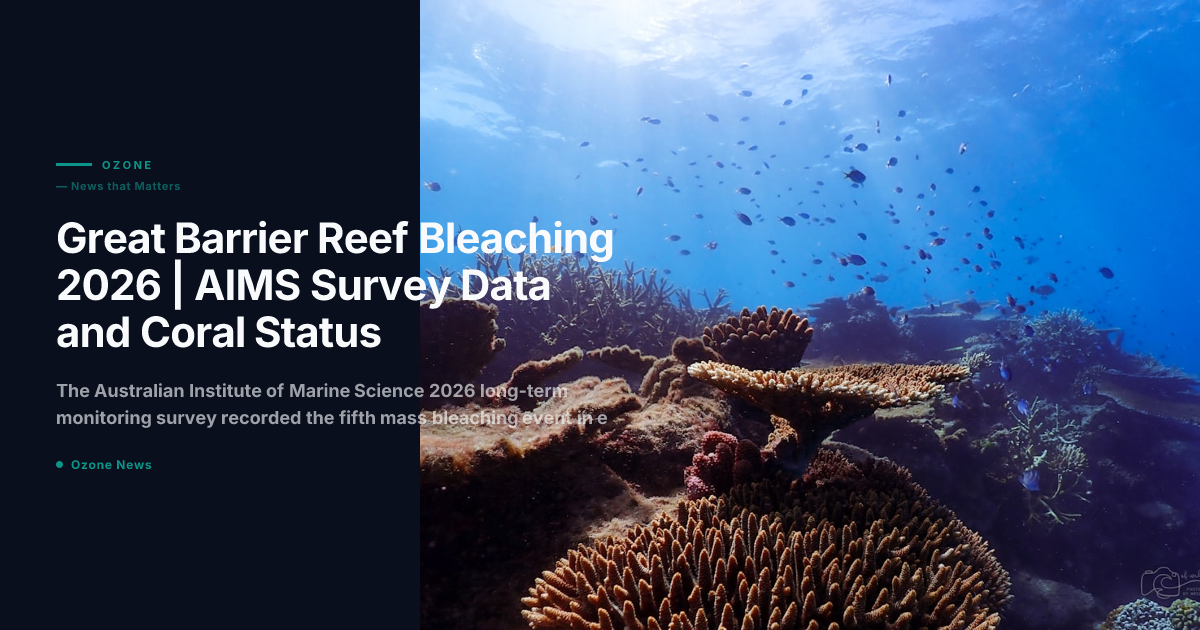
The Australian Institute of Marine Science (AIMS) released its 2026 Long-Term Monitoring Program annual summary in May 2026, documenting the fifth mass bleaching event on the Great Barrier Reef in eight years. The event, driven by anomalously high sea surface temperatures during the 2025-2026 summer, affected reefs across all three regions of the system. The report presents a complex picture: hard coral cover had recovered to a record high on the northern reef before the bleaching, but that recovery is now at risk.
2026 Bleaching Event | Scope and Severity
AIMS underwater survey teams and aerial overflight programs conducted during March and April 2026 documented the following:
- Bleaching extent: Approximately 73% of surveyed reefs showed some degree of bleaching, up from 60% in the 2024 event.
- Severe bleaching (greater than 60% of corals affected): Found on 44% of surveyed reefs, concentrated in the northern and central sections.
- Coral mortality from 2026 event: AIMS stated mortality estimates will not be available until follow-up surveys in September 2026, after the reef has had time to fully express post-bleaching die-off.
- Sea surface temperature anomaly: The AIMS Reef Temperature Monitoring System recorded a sustained positive anomaly of plus 1.2 to plus 2.4 degrees Celsius above the maximum monthly mean across the northern reef from January through March 2026.
AIMS Chief Executive Officer Dr. Paul Hardisty said in a press statement: "We are in a period of recurrent thermal stress. The reef's ability to recover between events is being tested in a way it has never been tested before."
Record Hard Coral Cover Before the Bleaching
The same AIMS monitoring report that documented the bleaching also recorded a notable achievement: hard coral cover on the northern Great Barrier Reef reached 36% in the 2025 survey, the highest level recorded in the 38-year monitoring dataset. The recovery followed several years of reduced Crown-of-Thorns starfish pressure and lower cyclone activity between 2021 and 2024.
This recovery makes the 2026 bleaching event particularly painful from a conservation perspective. Dr. Mike Emslie, AIMS research program leader, noted: "We had the most coral on the northern reef we have ever measured, and then we had one of the worst bleaching events we have ever recorded. That is the central problem. You can win on every other threat, but ocean warming will reset the clock."
Recovery Between Events | The Core Risk
Coral bleaching is not immediately lethal. When sea temperatures return to normal, bleached corals can reabsorb zooxanthellae algae and recover. The concern is the interval between events. AIMS data shows the average time between mass bleaching events on the Great Barrier Reef was 25 to 30 years before 1998. Since 1998, the reef has experienced mass bleaching in 1998, 2002, 2016, 2017, 2020, 2022, 2024, and now 2026. At this frequency, scientists say slow-growing massive coral species, which can take 100 years to reach full size, have no adequate recovery interval.
A 2022 study in Nature Climate Change found that bleaching conditions on the Great Barrier Reef now occur at water temperatures 0.5 degrees Celsius below the threshold that caused the 1998 bleaching, a sign that the remaining coral assemblage has shifted toward more heat-tolerant but ecologically less diverse species.
Crown-of-Thorns Starfish Program | Current Status
The AIMS report noted that Crown-of-Thorns starfish (COTS) populations are building in the northern reef following the recovery period. AIMS and the Great Barrier Reef Marine Park Authority's COTS control program injected approximately 490,000 starfish with ox bile bile bile injection in 2025, a 15% increase over the 2024 total. Despite this, AIMS outbreak models project an elevated COTS population through 2027, which will compound bleaching mortality if thermal stress continues.
Why This Matters
The Great Barrier Reef is the world's largest coral ecosystem, stretching 2,300 kilometers along the Queensland coast. It supports approximately 1,500 fish species, 4,000 mollusk species, 240 bird species, and six of the world's seven sea turtle species. Economically, it generates an estimated AU$6.4 billion annually in tourism and related industries. As a UNESCO World Heritage Site, it is subject to international monitoring, and the World Heritage Committee has previously flagged the reef for potential addition to the "in danger" list, a status Australia has lobbied against.
Frequently Asked Questions
- Is the Great Barrier Reef dying? It is under severe and recurring thermal stress. It has not died but is experiencing bleaching events at a frequency that prevents full recovery between events. Parts of the reef have permanently lost coral assemblage complexity.
- What causes coral bleaching? Sea surface temperatures rising above the maximum monthly mean for extended periods cause corals to expel the zooxanthellae algae that give them color and provide up to 90% of their energy. The white skeleton becomes visible, hence "bleaching."
- Can the reef recover from the 2026 bleaching? Some recovery is possible if 2026-2027 sea temperatures are normal. Full mortality from the current event will not be known until AIMS follow-up surveys in September 2026.
- What is AIMS? The Australian Institute of Marine Science. It is the government agency responsible for scientific research and long-term monitoring of tropical marine ecosystems including the Great Barrier Reef.