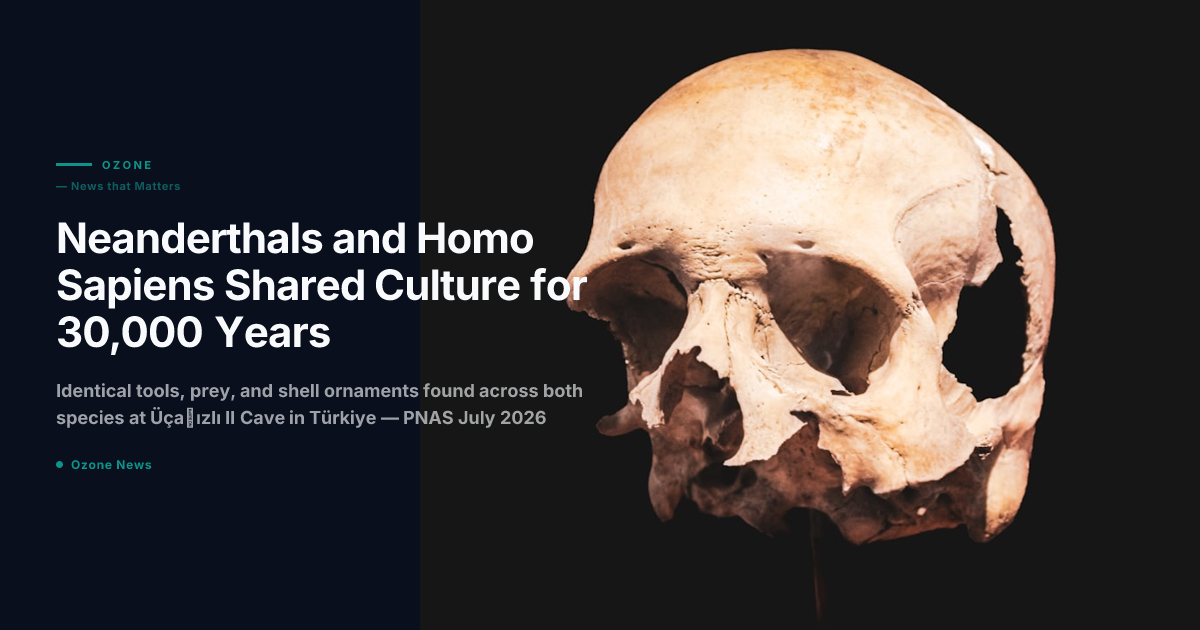
ISTANBUL, TÜRKIYE. On the Mediterranean coast of Türkiye, a sea cave has been quietly accumulating one of the most detailed records of human prehistory on Earth. Over a period spanning approximately 30,000 years, two distinct species used Üçağızlı II Cave as a base, hunted the same hills, made the same tools, and valued the same shells. A study published July 6 in the Proceedings of the National Academy of Sciences documents this record layer by layer, and its conclusion is striking: the cultural handoff between Neanderthals and Homo sapiens at this site was so seamless that biology alone cannot explain it. Culture, transmitted across the species boundary, appears to have been the dominant force shaping daily life at this site for tens of thousands of years.
Üçağızlı II Cave | A Migration Corridor Through Geological Time
The cave sits in the northern Levant, the geographic corridor connecting the African continent to Eurasia. This region was among the first pathways through which modern humans migrated out of Africa, and before them, a landscape that Neanderthals had inhabited for hundreds of thousands of years. Üçağızlı II is part of a cluster of cave sites in the area that have produced evidence of both species, but its particular value lies in the unusually complete and stratified nature of its sediment record. Each layer represents a distinct time window, and because the cave was occupied repeatedly rather than continuously, the layers remained largely undisturbed, allowing the international research team led by İsmail Baykara of Gaziantep University and Naoki Morimoto of Kyoto University to read the record with unusual precision.
The Neanderthal occupation layers date to approximately 77,000 to 59,000 years ago. Above those sit Homo sapiens layers dating to approximately 59,000 to 47,000 years ago. The biological turnover point is clear in the fossil record: human teeth found in the upper layers are anatomically modern. What is not clear is any corresponding cultural discontinuity. At the boundary between the two sets of layers, the material culture continues without interruption.
Evidence of Shared Culture | Tools, Prey, and Shell Symbolism
The research team identified three distinct categories of evidence for cultural continuity spanning the species transition. The first is stone tool technology. Both Neanderthals and early Homo sapiens at this site produced tools rooted in the Mousterian tradition, a knapping methodology characterized by prepared-core techniques that produce consistent, standardized flake tools. The Mousterian tradition is historically associated with Neanderthals across Europe and Western Asia, and its dominant presence in the Homo sapiens layers here is a significant departure from the expectation that modern humans would introduce distinctly different Upper Paleolithic toolkits when they arrived. The tools made by the cave's later occupants were, to a degree unusual in the archaeological record, nearly indistinguishable from those made by its earlier ones.
The second category is subsistence behavior. Faunal remains recovered from across all layers show that both species targeted the same suite of prey: wild goats, fallow deer, roe deer, and wild boar. These were not simply the only animals available in the region. The specific combination reflects strategic hunting preferences suited to the local terrain and seasonality, knowledge accumulated over generations of observation. The consistency of this prey profile across 30,000 years of occupation and across a full species replacement implies that this knowledge was not independently re-derived by arriving modern humans but was transmitted through contact or inherited from the local tradition.
The third and most provocative category involves symbolic behavior. Researchers found Columbella rustica seashells in layers attributed to both species. These small gastropod shells have no nutritional value and were clearly transported to the cave deliberately. Many show evidence of deliberate modification: perforation consistent with stringing as personal ornaments, and heat exposure that altered their surface color. The presence of identical symbolic objects, selected, transported, and modified in the same ways, across the species boundary is the strongest evidence in the dataset that something more than coincidence was at work.
Rethinking the Replacement Narrative
The dominant model of late Pleistocene human prehistory has long been one of replacement: modern humans arrive, Neanderthals vanish, and their material culture disappears with them. This framing is supported by sites like Grotte Mandrin in France, where Neanderthal and Homo sapiens layers are sharply differentiated with minimal evidence of cultural exchange. The Üçağızlı II data complicates this picture considerably. The cave was not a site of abrupt cultural rupture. It was a site of cultural continuity that persisted across a biological transition, a record more consistent with extended contact, interbreeding, or multigenerational knowledge transmission than with rapid territorial replacement.
This reading aligns with what genetic analysis has established over the past decade. Genomic studies have confirmed that non-African populations of Homo sapiens carry approximately one to four percent Neanderthal DNA, evidence of interbreeding events that occurred as modern humans moved through the Levant and into Eurasia. The Üçağızlı II archaeological record now adds a behavioral dimension to that genetic evidence. The two groups were not just occasionally mating. At sites like this one, they appear to have been operating within a shared cultural framework, passing down not just genes but tools, prey preferences, and symbolic objects across the species boundary over thousands of years.
"Our findings suggest that Neanderthals and Homo sapiens likely shared more than just the same landscape," lead author İsmail Baykara stated. The researchers note that further excavations are needed to confirm the precise mechanisms of cultural transmission, but the dataset as published represents some of the strongest behavioral evidence to date for an extended shared world between the two branches of the human family.
For more on human origins and evolutionary biology at OzoneNews, see coverage of the bumblebee problem-solving study challenging the boundaries of animal cognition and the Heliconius butterfly longevity genetics discovery. Related science coverage includes the pigeon magnetic navigation discovery linking liver macrophages to navigation and the AION atom interferometer dark matter detection breakthrough.