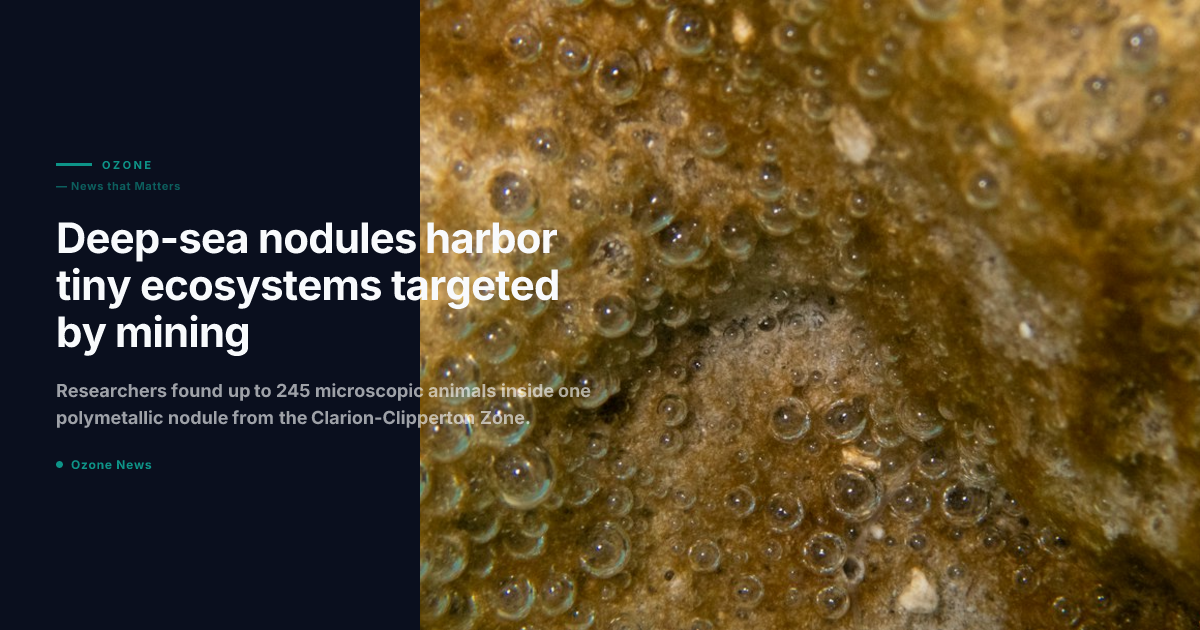
Commercial interest in extracting nickel, cobalt, copper, and manganese from the deep ocean is colliding with a biological discovery. Marine researchers examining potato-sized polymetallic nodules from the Pacific Ocean's Clarion-Clipperton Zone, or CCZ, found a hidden community living inside the rocks themselves.
The study examined 244 nodules and recorded 4,139 microscopic animals, including nematodes, copepods, and single-celled organisms. The largest count from one nodule reached 245 animals. The result changes the ecological question around deep-sea mining: the rocks are not only mineral deposits scattered across mud, but also hard, porous refuges in an otherwise soft abyssal plain.
DEEP-SEA NODULE ECOSYSTEM SUMMARY
├── Region: Clarion-Clipperton Zone, central Pacific
├── Depth: About 4,000 to 6,000 meters
├── Samples: 244 polymetallic nodules
├── Animals counted: 4,139 microscopic organisms
└── Maximum in one rock: 245 animals
Why polymetallic nodules make unusual habitat
The Clarion-Clipperton Zone covers a vast area of abyssal plain between Hawaii and Mexico. Much of the seafloor is fine sediment, with nodules scattered across the surface. The dark rocks contain manganese and iron oxides along with nickel, cobalt, and copper, which is why they have attracted companies and governments seeking materials for batteries and other technologies.
For meiofauna, the nodules provide something the surrounding mud cannot: a network of cracks, pores, and protected internal surfaces. These spaces create a three-dimensional shelter and may support food, moisture, and microhabitats that remain distinct from the sediment community. The animals are tiny, but the habitat function is large because the rocks are distributed across a broad and otherwise relatively uniform plain.
The research also found that internal nodule communities could remain similar across distances approaching 1,000 kilometers while differing from organisms in adjacent sediment. That separation suggests the rocks support a specialized community rather than simply trapping animals that would otherwise live in the mud.
ScienceDaily's report on the nodule study describes the discovery of the internal ecosystem and its relevance to proposed mining operations.
| Target or measure | Setting | Resource or signal | Ecological finding |
|---|---|---|---|
| Polymetallic nodules | CCZ abyssal plain | Nickel, cobalt, copper, manganese | Up to 245 animals inside one rock |
| Regional biodiversity surveys | Clarion-Clipperton Zone | Benthic communities | 788 species recorded in surveyed areas |
| Mining test tracks | Disturbed seafloor | Nodule and sediment removal | 37 percent decline in animal density |
| Seamount crusts and sulfides | Seamounts and ridges | Cobalt and other metals | Different habitats with separate ecological risks |
What the biodiversity numbers show
The nodule study is part of a larger picture of poorly known life in the CCZ. Regional surveys have cataloged 788 species, with a large share considered new to science. Those counts are not a complete inventory. They represent what researchers could identify from particular sampling areas, which means the true diversity and geographic range of the ecosystem remain uncertain.
That uncertainty cuts in both directions. It is not proof that every nodule hosts the same number of animals, and it does not establish that every species depends exclusively on nodules. It does show that a resource deposit can function as habitat, and that removing it may alter communities that scientists have only begun to describe.
Mining machinery can affect more than the rock being collected. Crawlers disturb the upper sediment layer and create plumes that may spread suspended particles beyond the collection path. Animals that depend on stable sediment, low light, and slow nutrient transport could be affected even when a nodule is not directly removed.
OzoneNews coverage of the oceans and deep-sea science tracks how remote environments can hold ecological functions that are difficult to see from the surface. The CCZ adds a new example: the visible rock is also a habitat boundary.
Why recovery could take millions of years
Polymetallic nodules accumulate from minerals dissolved in seawater at rates measured in millimeters over millions of years. A mining vehicle can remove a deposit in hours, but natural replacement of the hard substrate is far slower than the life cycle of most familiar ecosystems.
That mismatch makes nodule mining different from harvesting a renewable surface resource. Sediment communities may begin to recolonize disturbed tracks, but recolonization does not recreate the original rock habitat. A replacement community could be less diverse, composed of different species, or dependent on another source of hard structure that is not available across the plain.
DEEP-SEA EXTRACTION AND HABITAT LOSS CYCLE
├── Collection: Crawlers remove nodules and disturb surface sediment
├── Plume: Suspended particles move through nearby water and seafloor
├── Habitat loss: Porous hard shelters disappear from the plain
└── Recovery limit: New nodules form over geological timescales
A study of test mining tracks reported a 37 percent decline in animal density in disturbed areas. That number is a local ecological measurement, not a prediction of a uniform decline across every future mine. It is nevertheless a warning that physical disturbance can leave a biological signal after the machinery has passed.
What the findings mean for seabed regulation
The International Seabed Authority regulates mineral exploration in international waters, including parts of the CCZ. Regulators must evaluate proposed operations with incomplete information about species ranges, recovery rates, sediment plumes, and the role of nodules as habitat.
The new evidence does not by itself settle whether deep-sea mining should proceed. It changes what a full environmental assessment must count. A nodule cannot be treated only as a piece of ore if it also supports organisms inside its pores, contributes structure to an abyssal community, and may take millions of years to form again.
Researchers and conservation groups have called for protected areas and representative reserves that preserve both sediment and nodule habitats. OzoneNews reporting on environmental policy, marine research, and resource accountability examines the broader question of how regulators weigh uncertain ecological losses against material demand.