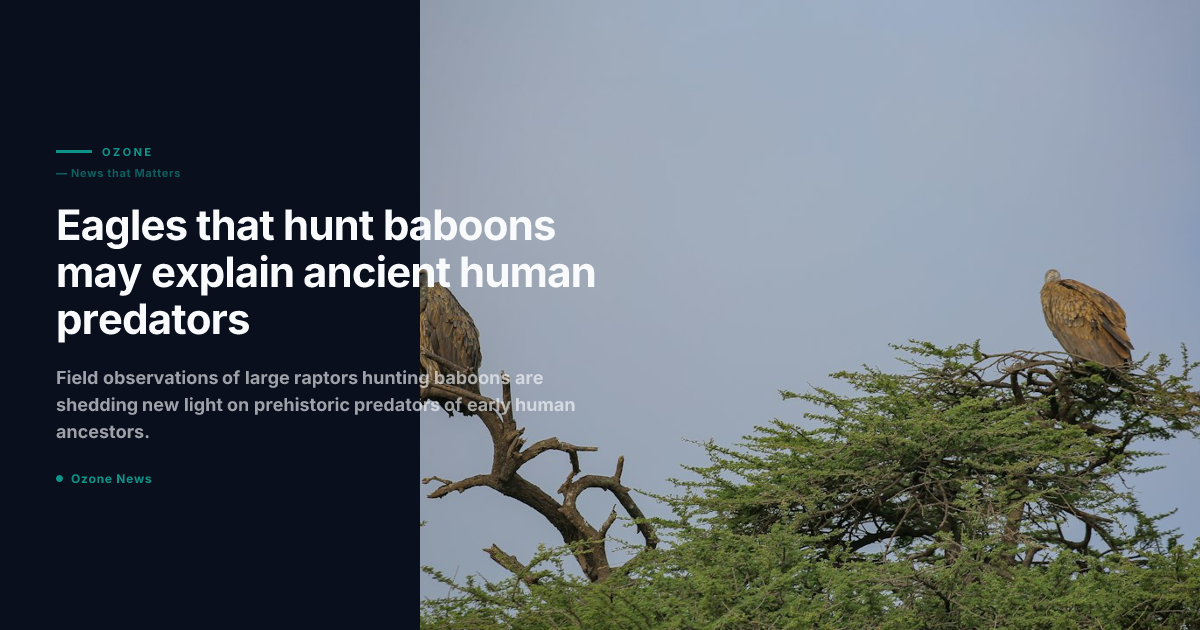
Documented observations of large African raptors preying on baboons weighing up to 60 pounds (27 kilograms) are prompting researchers to re-examine the role of avian predators in early human evolution.
Because many extinct hominins, such as Australopithecus africanus, were similar in size and weight to modern juvenile and adult baboons, modern raptor hunting behavior provides a direct ecological model for how prehistoric birds of prey interacted with early human ancestors millions of years ago.
PREDATOR-PREY COMPARISON SUMMARY
├── Modern Raptor Model: African crowned eagle (Stephanoaetus coronatus) and martial eagle
├── Documented Prey Weight: Baboons weighing up to 60 pounds (27 kg)
├── Prehistoric Parallel: Early hominins (Australopithecus, ~60-90 lbs / 27-41 kg)
├── Key Fossil Evidence: The Taung Child skull (puncture marks in eye sockets)
└── Evolutionary Impact: Predation pressure shaped social grouping and vigilance behaviors
The Mechanics of Large-Primate Predation
Despite weighing between 7 and 14 pounds themselves, apex forest and savanna raptors, most notably the African crowned eagle (Stephanoaetus coronatus) and the martial eagle (Polemaetus bellicosus), possess massive talons and crushing grip strength capable of subduing primates several times their own body weight.
Rather than carrying a 60-pound carcass away intact, these raptors typically strike from concealed perches, severing the spinal cord or vital blood vessels upon impact before dismembering the prey on the ground and transporting smaller portions back to their nests.
That dismemberment behavior matters to the fossil record. An eagle that feeds a monkey in place and hauls off pieces leaves behind a scattered, partially consumed carcass rather than a clean skeleton. Taphonomists read that pattern of damage, and it looks different from what a big cat leaves, which is why the distinction is forensically usable rather than merely speculative. Coverage of these methods appears in the American Journal of Biological Anthropology.
Comparative Size and Predation Metrics
| Species / Specimen | Estimated Body Weight | Primary Habitat | Predation Relevance |
|---|---|---|---|
| African crowned eagle | 7 to 10 lbs (3.2 to 4.5 kg) | Sub-Saharan forests | Specializes in mammalian and primate prey |
| Chacma or olive baboon | 30 to 60+ lbs (14 to 27+ kg) | African savannas and woodlands | Modern behavioral and size analog |
| Taung Child (A. africanus) | About 20 to 26 lbs (9 to 12 kg) | Pliocene South Africa | Fossil skull displays talon puncture marks |
| Adult Australopithecus | About 65 to 90 lbs (29 to 41 kg) | Pliocene and Pleistocene Africa | Comparable to large modern primates |
Revisiting the Taung Child Fossil Evidence
The ecological parallel directly reinforces one of paleoanthropology's most famous forensic discoveries: the Taung Child, a 2.8-million-year-old fossilized skull of a juvenile Australopithecus africanus discovered in South Africa in 1924, as documented by the Smithsonian National Museum of Natural History.
For decades, anthropologists assumed the young hominin had been killed by a saber-toothed cat or leopard. However, comparative forensic analyses revealed distinct puncture marks inside the eye sockets and depressed fractures on the cranium that match the exact talon spacing and beak damage left by modern African crowned eagles feeding on monkeys and baboons.
              The Taung Child Forensic Comparison
   [Skull Damage Pattern Observed in the Fossil]
                            |
            +---------------+---------------+
            v                               v
   [Big Cat Hypothesis]              [Raptor Hypothesis]
   Shearing from carnassial          Punctures matching talon
   teeth, jaw-spaced holes           spacing, beak scoring on
   expected across face              orbits and cranial vault
            |                               |
            +---------------+---------------+
                            v
   [Damage pattern aligns with crowned eagle feeding on primates]
The reason the baboon data matters is that it supplies a living calibration. A fossil cannot be watched dying, but a crowned eagle can be watched killing a monkey of comparable mass, and the damage it leaves can be measured against the damage on the bone. That is what turns an intuitive reading into a testable one.
Evolutionary Pressures on Early Hominins
Recognizing birds of prey as consistent predators of primates up to 60 pounds alters how scientists reconstruct early human daily life.
Unlike terrestrial predators such as big cats or hyenas, avian predators attack silently from above, forcing primate species to develop specialized alarm calls, cooperative troop defense, and heightened canopy awareness. Researchers note that surviving aerial predation likely reinforced the complex social cohesion and communication systems that became hallmarks of early hominin survival.
This is the same logic that makes living animals useful to paleoanthropology elsewhere in our coverage. Our report on the American cheetah that was never a cheetah shows how convergent evolution misleads the reading of form, and the wood frog that survives being frozen is another case where modern physiology is used to infer conditions deep in the past. The through-line is identical: the present is the key to the past, provided the analogy is size- and behavior-matched rather than merely suggestive.
For the deeper fossil and artifact record, see our archaeology coverage hub, and for the living-animal side of these questions, our animals coverage hub.
Frequently Asked Questions
The uncomfortable elegance of the argument is its ordinariness. No one has to believe a monster took the Taung Child. We only have to accept that the largest eagle alive today already kills animals the size of a small child, does it for a living, and leaves a signature on bone that we can measure. Early hominins did not evolve under a sky that was merely scenery.