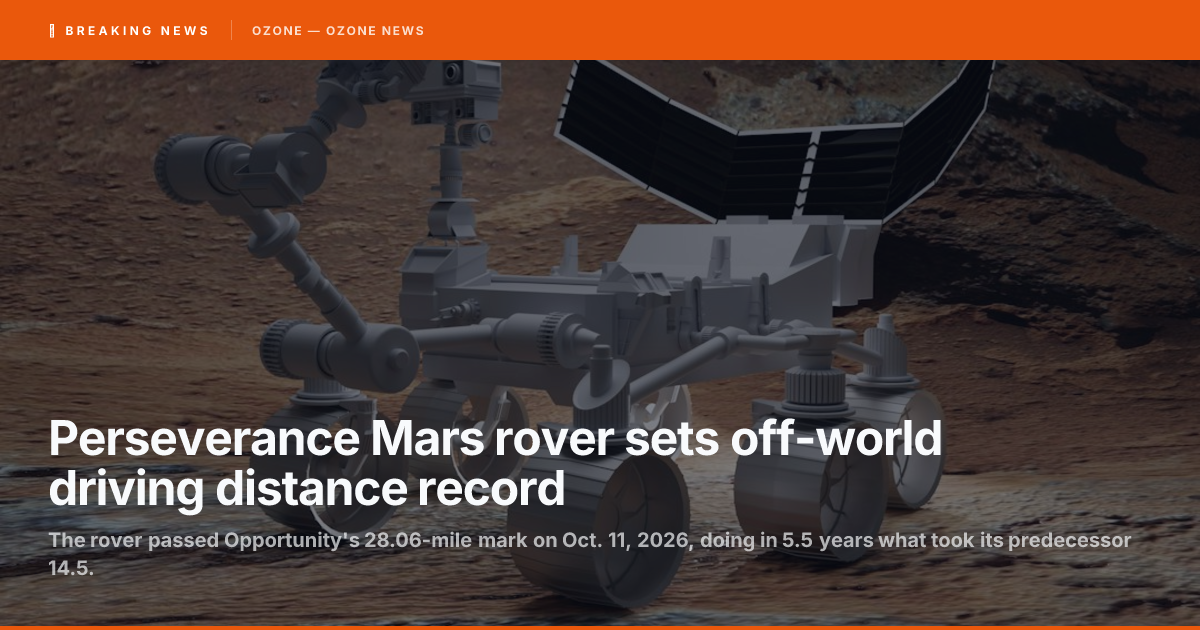
PASADENA, Calif. On October 11, 2026, on its 2,006th Martian day (sol) of operations, NASA's Perseverance Mars rover officially rolled into spaceflight history.
A 299.6-foot (91.3-meter) trek across a region known as Lac de Charmes pushed the six-wheeled robot's cumulative odometer to 28.10 miles (45.22 kilometers). With that milestone, Perseverance officially surpassed the long-standing off-world driving record of 28.06 miles (45.16 kilometers) established by NASA's legendary Opportunity rover, as reported in NASA's mission blog.
Off-World Driving Distance Leaderboard
├── 1. Perseverance (NASA / Active): 28.10 miles (45.22 km) - Achieved Oct. 11, 2026
├── 2. Opportunity (NASA / Inactive): 28.06 miles (45.16 km) - Set over 14.5 years (2004-2018)
├── 3. Lunokhod 2 (USSR / Inactive): ~24.2 miles (39.0 km) - Set on the Moon in 1973
└── 4. Curiosity (NASA / Active): ~23.7 miles (38.15 km) - Exploring Mount Sharp
The achievement is far more than a simple numerical landmark. It demonstrates a generational leap in robotic engineering, autonomous navigation, and planetary exploration efficiency.
The Tech Gap | Why Perseverance Did in 5 Years What Took Opportunity 15
While Opportunity took nearly 15 years (2004 to 2018) to log 28.06 miles, Perseverance eclipsed that distance in just 5.5 years.
This massive speed differential comes down to three primary technological advances.
Key Technological Upgrades Across Generations
├── Power Source: Solar arrays (Opportunity) vs. radioisotope thermoelectric generator / RTG (Perseverance)
├── Navigation Autonomy: Human-in-the-loop steps vs. AutoNav 3D real-time hazard mapping
└── Computing Power: 20 hazard points (Sojourner) vs. ~600,000 evaluations per look (Perseverance)
1. Constant Nuclear Power
Opportunity relied entirely on solar panels, forcing it to hibernate through cold Martian winters and face constant dust accumulation that eventually ended its mission in 2018.
In contrast, Perseverance is powered by a Multi-Mission Radioisotope Thermoelectric Generator (MMRTG), which converts heat from decaying plutonium-238 directly into electricity, providing uninterrupted power night and day, winter or summer.
2. AutoNav Autonomous Driving
Where earlier rovers had to wait for human engineers at NASA's Jet Propulsion Laboratory (JPL) to analyze imagery and send step-by-step driving commands across millions of miles, Perseverance is equipped with AutoNav (Autonomous Navigation).
AutoNav continuously captures 3D terrain images while moving, mapping hazards, making steering decisions, and driving through boulder fields in real time without stopping to check in with Earth.
                Perseverance AutoNav Real-Time Pipeline
      [Navigation Cameras Capture 3D Stereo Images]
                            |
                            v
      [AutoNav Processes ~600,000 Spatial Hazard Points]
                            |
                            v
      [Onboard Computer Calculates Safe Path in Real Time]
                            |
                            v
      [Continuous Wheels-In-Motion Driving Across Rugged Terrain]
3. A Rover Built to Overperform Its Spec
Perseverance's odometer tells a second story. The mission was designed around a minimum of 12.4 miles (20 km) of driving, and it has now more than doubled that baseline while still healthy. The record was confirmed by JPL navigators tracking each sol's wheel odometry against orbital imagery.
Exploring Ancient Hydrothermal Systems
Perseverance broke the record while ascending toward a region called Idubi, situated along the western rim of Jezero Crater.
The geology in this area contains some of the oldest exposed rock formations in the solar system, terrain so ancient that equivalent rocks on Earth have long been destroyed by plate tectonics and erosion.
Current Science Objectives (Jezero Crater Rim)
├── Target Zone: Idubi and Lac de Charmes regions along Jezero's western rim
├── Scientific Goal: Search for ancient hydrothermal (heated water) mineral signatures
└── Core Sample Collection: Sealing rock cores for future Mars Sample Return retrieval
Scientists suspect that the fractures around Idubi once hosted ancient hydrothermal vents. If life ever existed on early Mars, mineralized deposits near warm, subterranean water channels offer one of the best targets to preserve organic biosignatures.
That search for habitable environments beyond Earth is the same question driving other planetary science. Perseverance is sampling an ancient lake bed, while mission concepts for Saturn's moon Enceladus propose flying a spacecraft directly through the plumes of a subsurface ocean to taste it without landing. The rock-reading toolkit also overlaps with terrestrial geology coverage, where the same mineral signatures Perseverance hunts for on Mars are used to date ancient hydrothermal systems on Earth.
| Parameter / Milestone | Perseverance Mission Baseline |
|---|---|
| Landing Date | February 18, 2021 (Jezero Crater floor) |
| Original Design Baseline | Minimum 12.4 miles (20 km) planned driving distance |
| Current Mission Phase | Extended Mission (approved through late 2028) |
| Rock Core Samples Sealed | 25-plus hermetically sealed titanium sample tubes cached |
What the Record Does Not Mean
An odometer milestone is a public-facing marker, not a science result. The distance Perseverance travels matters to engineers because driving is the scarcest resource on a rover: every meter is paid for in power, time, and wheel wear. The more ground a rover covers per sol, the more rock it can examine, and that is why autonomy and nuclear power change the science as much as the headline number.
It also reframes Opportunity's record rather than diminishing it. Opportunity drove 28.06 miles on sunlight alone, through dust storms that ended its mission, with a fraction of Perseverance's onboard computing. The newer rover did not simply drive more; it drove smarter and never had to sleep through the winter.
Frequently Asked Questions
The rover that was built to drive 20 miles has now passed 28 and keeps going, on a schedule approved through late 2028. The next odometer milestone will not be a record. It will just be another week of Perseverance doing the thing it was designed to do, slowly working its way up a 3.5-billion-year-old crater rim, one autonomous sol at a time.