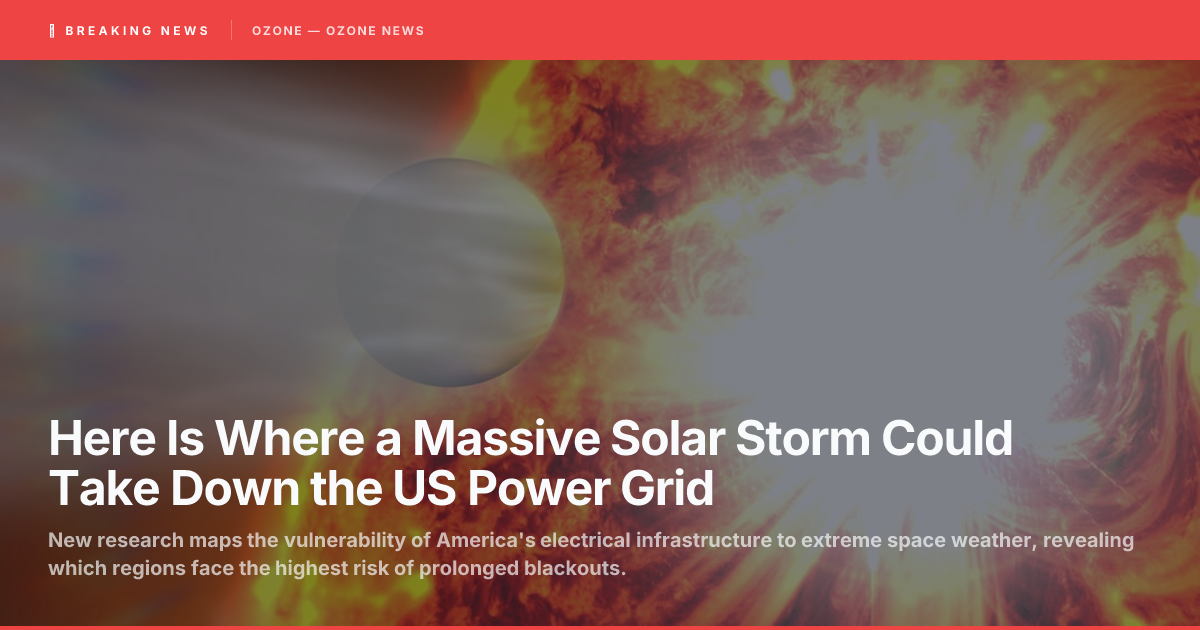
The same solar outburst that paints spectacular auroras across the night sky also carries a darker threat: the potential to bring America's electrical grid to its knees. New research published across multiple scientific outlets has mapped the vulnerability of the United States power grid to extreme solar storms with unprecedented precision, identifying the regions most likely to face prolonged blackouts when the next major space weather event arrives.
Reported by CNN, Eos, and Quartz, the converging studies paint a sobering picture of critical infrastructure vulnerability to space weather, a threat that has historically received far less attention than hurricanes, earthquakes, or cyberattacks.
The Carrington-Class Threat | A 150-Year Recurrence
The benchmark for extreme space weather events remains the Carrington Event of 1859, a solar storm so powerful that it set telegraph wires on fire and created auroras visible as far south as Cuba and Mexico. In the 167 years since, Earth has experienced several close calls, including the 1989 Quebec blackout that knocked out the province's entire power grid for nine hours, and the 2012 solar storm that narrowly missed Earth, passing through its orbit where the planet had been just one week earlier.
A Carrington-class event today would interact with a fundamentally different world. The 1859 telegraph network has been replaced by a continent-spanning electrical grid with more than 200,000 high-voltage transformers, a satellite infrastructure worth hundreds of billions of dollars, and a communications network that underpins every aspect of modern life. The new research models what happens when that infrastructure meets a storm of comparable magnitude.
The studies identify the Mid-Atlantic region, the Pacific Northwest, and the Upper Midwest as the areas at highest risk. These regions sit atop geological formations that conduct geomagnetic induced currents (GICs) more efficiently, effectively funneling the electrical disturbance into the transformers that serve millions of customers. A single large transformer can take 12 to 24 months to replace, and many are custom-built with no readily available spares.
The Economic Toll | Billions Per Day
The economic consequences of a major solar storm have been notoriously difficult to estimate, in part because no modern economy has experienced a Carrington-class event. The new research, covered by Eos, provides some of the most detailed projections to date, modeling daily losses across multiple sectors including transportation, finance, healthcare, and manufacturing.
The estimates are staggering. A major grid-disrupting solar event could cause daily economic losses reaching into the tens of billions of dollars, with the hardest-hit regions facing recovery timelines measured in years rather than months. The cascading effects of a prolonged blackout would extend far beyond the directly affected areas, as supply chains, financial systems, and emergency services all depend on continuous electrical power.
Alaska researchers, as reported by the Peninsula Clarion, have found that extreme solar storms could pack an even bigger punch than previously modeled. High-latitude infrastructure, including the electrical grids serving Alaska and northern Canada, may experience stronger geomagnetic induced currents than standard models predict, suggesting that the threat to northern power infrastructure may be significantly underestimated.
The Preparedness Gap | What Can Be Done
The research highlights a critical gap in US infrastructure preparedness. While the electric power industry has made significant strides in recent years, including the deployment of monitoring equipment and the development of mitigation strategies, many high-risk transformers still lack the protective equipment needed to withstand a severe geomagnetic disturbance.
Mitigation strategies fall into several categories. Transformer-level protection includes devices that block or divert geomagnetic induced currents before they reach sensitive windings. System-level protection involves operational procedures such as reducing grid load during a storm to give transformers more headroom. Strategic stockpiling of spare transformers, while expensive, could dramatically reduce recovery times. The studies suggest that a coordinated federal investment in grid hardening could reduce the economic impact of a major solar storm by an order of magnitude.
The threat is not hypothetical. The sun follows an approximately 11-year activity cycle, and the current cycle, Solar Cycle 25, has been more active than forecasters predicted. Several close calls in recent decades, including the 2012 storm that missed Earth and the 2017 storm that caused airline rerouting and communications disruptions, serve as reminders that the next Carrington-class event is a matter of when, not if.
As the research community continues to refine its models and the power industry continues to harden its infrastructure, the question is no longer whether a major solar storm will hit Earth, but whether the grid will be ready when it does. The new studies provide the most detailed roadmap yet of where the risks are highest and what must be done to address them.
Frequently Asked Questions
As one researcher noted in the Eos report: "We know a Carrington-class event will happen again. The question is whether our infrastructure will be ready when it does." The new studies provide the most detailed roadmap yet of where the risks are highest and what must be done to address them.