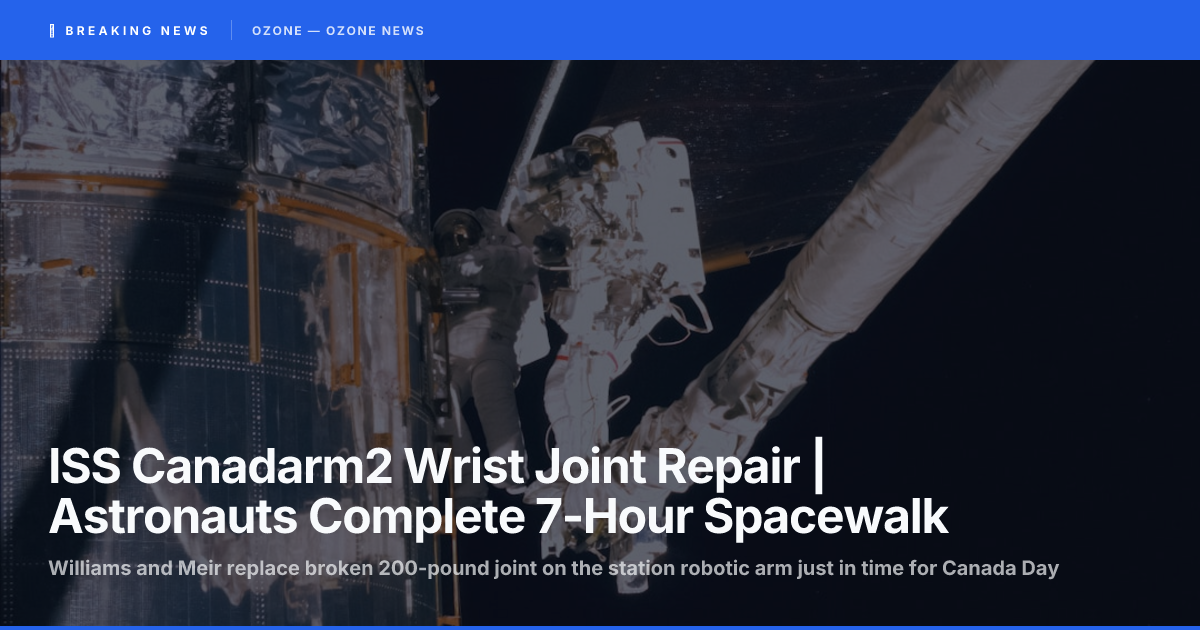
INTERNATIONAL SPACE STATION Floating 260 miles above Earth, two NASA astronauts successfully executed a complex round of orbital surgery on June 30. During a grueling seven-hour and 20-minute spacewalk, flight engineers Chris Williams and Jessica Meir replaced a malfunctioning 200-pound wrist joint near the tip of the International Space Station primary robotic arm, Canadarm2. The excursion, officially logged as US Spacewalk 95, restored full operational capabilities to the station workhorse manipulator just a day before Canada Day, a timing coincidence celebrated by both NASA and the Canadian Space Agency (CSA).
Canadarm2 Failure | Joint No. 5 Anomaly Detected May 27
The physical intervention became necessary after ground controllers at the Johnson Space Center in Houston noticed a severe mechanical anomaly on May 27. During routine station operations, one of Canadarm2 seven motorized joints (Joint No. 5) began drawing an abnormally high electrical current while refusing to move as expected. Engineers determined that no software workaround could bypass the physical blockage. Because the arm was designed with modular swappable components, mission managers fast-tracked an EVA to swap out the failed hardware with a spare joint that had been mounted on an external storage platform on the station hull.
Why Canadarm2 Matters | The Backbone of ISS Operations
Spanning 57 feet (17.4 meters) and weighing more than 3,300 pounds, Canadarm2 has been the literal backbone of ISS operations since it was delivered by the space shuttle Endeavour in 2001. Its core functions include grappling incoming cargo ships such as the SpaceX Dragon and JAXA HTV, acting as mobile scaffolding during risky spacewalks, and relocating itself across the hull by swapping its base anchor in an inchworm motion. Without a fully functioning arm, the ISS cannot easily position large spare components, assist astronauts during complex exterior repairs, or capture certain visiting commercial cargo vehicles.
The 7-Hour Orbital Repair | Step by Step
The repair unfolded across four major phases. During hour one, Williams and Meir exited the Quest airlock, retrieved specialized microgravity pistol-grip power tools and foot restraints, and migrated to the external equipment storage platform to unbolt the spare wrist joint. Hours two and three involved detaching the arm mechanical hand, known as the Latching End Effector (LEE), along with two adjacent healthy joints. This massive 900-pound LEE cluster was temporarily bolted to a storage shelf to keep it from drifting in microgravity.
During hours four and five, Williams unbolted the broken 200-pound Joint No. 5 from the arm main boom, moved it to a temporary spot, and aligned the fresh spare joint into place, securing the heavy structural fasteners. In hour six, the crew retrieved the 900-pound LEE cluster from the temporary shelf, matched the alignment keys, and mated it back onto the newly installed joint, re-engaging all underlying electrical data lines. Mission Control then powered up the arm remotely, verifying that data strings and electrical power currents had stabilized across the entire assembly.
Williams carried the failed joint back inside the airlock. It will eventually be loaded onto an incoming cargo capsule to be returned to Earth, where engineers will disassemble and analyze the component to prevent future architectural fatigue. This marked the 280th spacewalk dedicated to ISS assembly and maintenance, the fifth career EVA for veteran astronaut Jessica Meir, and the second for Chris Williams.
For more ISS and NASA coverage, see OzoneNews reporting on the ISS Zvezda air leak and Dragon shelter order and the NASA Swift Observatory rescue mission. Related space coverage includes Artemis 3 mission status and launch window and MAVEN Mars orbiter mission conclusion.