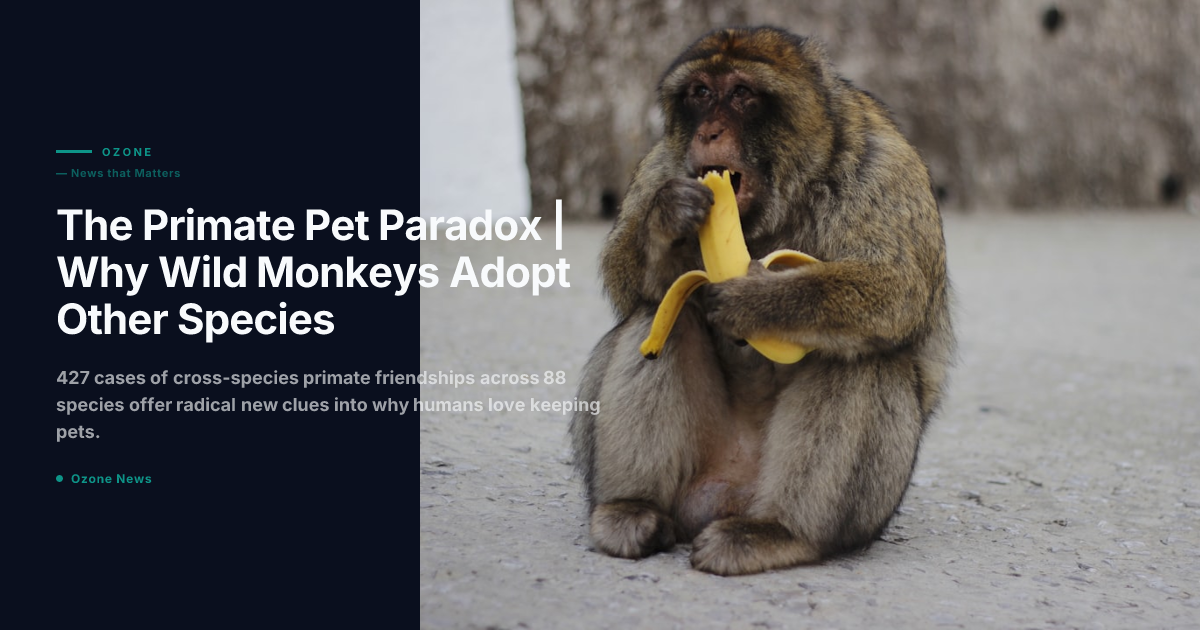
A landmark international review led by Dr. Cyril Grueter of the University of Oxford, published in the journal Primates, has compiled 427 distinct cases of cross-species primate friendships involving 88 primate species and 127 partner species, 55 of which were entirely non-primate animals. The study reveals that wild monkeys and apes regularly play with, groom, carry, and even adopt entirely different animals, behaviors that mirror the exact arc of human-animal companionship from childhood play to adult caretaking. These findings provide the strongest evidence yet that the foundations of pet-keeping are not a uniquely human cultural invention but an ancient evolutionary capacity rooted deep in the primate lineage.
Key Takeaways
- 1The study compiled 427 distinct cross-species interaction cases involving 88 primate species and 127 partner species, 55 of which were non-primate animals like dogs, deer, pigs, and squirrels.
- 2In Brazil, a female bearded capuchin named Chiquinha adopted an infant marmoset named Fortunata, raising her with full maternal care for over a year while the troop modified its behavior to protect the fragile newcomer.
- 3In Thailand, wild stump-tailed macaques regularly seek out domestic dogs near temples and spend hours grooming them, picking dirt and parasites from their fur in a behavior that mirrors human pet caretaking.
- 4Dr. Grueter's team proposes an 'evolutionary spillover' hypothesis: the primate brain's hyper-social neural wiring, optimized for empathy and maternal care toward kin, easily overflows onto other species that trigger the same protective instincts.
- 5The behavioral arc observed in primates, from juvenile play to adult grooming to rare full adoption, follows the exact same developmental trajectory seen in human-animal bonds from childhood to maturity.
- 6The findings suggest the human capacity for pet-keeping is not a modern cultural quirk but a deep evolutionary inheritance shared across the primate order, predating the emergence of Homo sapiens by millions of years.
For generations, anthropologists have treated the human habit of pet-keeping as a completely unique, highly anomalous cultural quirk. Why would an organism expend precious metabolic energy, share hard-won food reserves, and dedicate hours of labor to care for an entirely different species that offers zero genetic payout? The question has lingered at the edges of evolutionary biology for decades, largely unanswered because the evidence simply was not there. A landmark international review published in the journal Primates, led by Dr. Cyril Grueter of the University of Oxford, has changed that. The answer, it turns out, is that we are not nearly as unique as we thought.
The Grueter Database | 427 Cases Across 88 Primate Species
The research team drew data from a meticulous combination of peer-reviewed scientific literature, field observations from practicing primatologists, and verified media documentations spanning decades of fieldwork across Asia, Africa, and South America. The resulting database is the most comprehensive catalog of interspecific primate social behavior ever assembled: 427 distinct cases involving 88 different primate species and 127 partner species. Critically, 55 of those partner species were entirely non-primate animals, including domestic dogs, wild deer, forest pigs, grizzled squirrels, and even small rodents.
What makes the dataset especially powerful is its breadth across the primate order. The behaviors were documented in prosimians, New World monkeys, Old World monkeys, and apes, spanning the full phylogenetic range. This is not a quirk of one weird troop in one forest. It is a pattern distributed across the entire primate lineage, suggesting an ancient, deeply conserved capacity rather than a recent, culturally transmitted oddity.
How comprehensive is the Grueter et al. 2026 database on cross-species primate friendships?
The database catalogs 427 distinct cases of affiliative interspecific interactions involving 88 different primate species and 127 partner species. Of those partner species, 55 were entirely non-primate animals including domestic dogs, wild deer, pigs, squirrels, and rodents. The data spans prosimians, New World monkeys, Old World monkeys, and apes across Asia, Africa, and South America, making it the largest dataset of its kind ever assembled.
427 cases, 88 primate species, 127 partner species
Grueter et al., Primates, July 2026 | University of Oxford
Source: Grueter et al., Primates, 2026
The Spectrum of Primate Friendships | From Play to Adoption
The study reveals that primate interactions with other animals span a remarkably broad behavioral spectrum, mirroring the exact way human-animal bonds evolve across a human lifespan. Juvenile primates engage in high-intensity cross-species play, chasing, wrestling, and mock-fighting with animals they have no evolutionary reason to interact with. As primates age, these playful interactions transition into more deliberate affiliative behaviors: tactile grooming, carrying, and protective vigilance. At the rarest and most extraordinary peak of the spectrum lies full interspecific adoption, where a primate takes on long-term caretaking responsibility for an animal of an entirely different species.
The database documents an array of strikingly distinct pairings across the globe. In Thailand, wild stump-tailed macaques regularly seek out domestic dogs wandering near Buddhist temples, spending hours fastidiously picking dirt and parasites out of the dogs' fur in a grooming behavior indistinguishable from how they treat their own troop members. In Sri Lanka, tufted gray langurs have been documented gently stroking the backs of giant grizzled squirrels resting on tree branches, a behavior that serves no obvious survival function and appears to be purely affiliative. In the dense mountain forests of China, juvenile black-and-white snub-nosed monkeys frequently drop down from the canopy to engage in elaborate games of tag and mock-wrestling with wild and domestic pigs. At the Shanghai Zoo, researchers monitored a female northern white-cheeked gibbon that carried a small wild mouse in her palm for days, protecting it from other primates and treating it with immense physical gentleness.
What types of cross-species behaviors do primates exhibit?
The study identifies a behavioral spectrum that mirrors human-animal bond development: juvenile primates engage in high-intensity cross-species play like chasing and wrestling, adults transition to affiliative behaviors including tactile grooming and carrying, and at the rarest peak, full interspecific adoption occurs where a primate assumes long-term caretaking of another species. Documented examples include stump-tailed macaques grooming dogs in Thailand, tufted gray langurs stroking squirrels in Sri Lanka, and snub-nosed monkeys playing tag with pigs in China.
Source: Grueter et al., Primates, 2026
The Case of Fortunata | A Marmoset Raised by Capuchins
The most extraordinary case highlighted in the review takes place in the woodlands of Brazil, detailing a phenomenon that looks remarkably like true human pet-keeping or adoption. In 2004, field biologists monitoring a troop of wild bearded capuchin monkeys noticed an adult female named Chiquinha carrying an infant on her back. The baby was not a capuchin. It was a marmoset, a drastically smaller, completely distinct monkey species from an entirely different primate family. The researchers named the tiny infant Fortunata.
What followed over the subsequent year shocked the scientific community. Chiquinha, and later a second female named Dende, raised Fortunata with the exact same level of hyper-vigilant maternal care given to biological capuchin infants. The entire troop adapted its social dynamic to accommodate their tiny companion. When young capuchins played with Fortunata, they consciously modified their physical strength to avoid injuring the fragile marmoset, a level of motor awareness and social consideration that is difficult to explain through standard behavioral models. Fortunata learned to understand capuchin vocalizations, foraged alongside the troop, and even actively participated in defensive maneuvers, helping the monkeys mob predatory snakes. She lived successfully as a member of the capuchin troop for over a year until reaching near-adulthood, a developmental span that represents an enormous investment of energy and protection from her adoptive family with zero genetic return.
What happened in the case of Fortunata the marmoset adopted by capuchin monkeys?
In 2004 in Brazil, a female bearded capuchin named Chiquinha adopted an infant marmoset, a completely different monkey species, and raised her with full maternal care for over a year. The capuchin troop adapted its behavior, modifying play strength to avoid injuring the fragile marmoset. Fortunata learned capuchin vocalizations, foraged with the troop, participated in snake-mobbing defenses, and was later passed to a second adoptive mother when the first became pregnant. This case represents one of the most complete cross-species adoptions ever documented in wild primates.
Over 1 year of cross-species adoption
Fortunata's integration into the capuchin troop | field observations, Brazil 2004
Evolutionary Spillover | Why the Primate Brain Reaches Across Species
From a strict evolutionary perspective, behavior that does not advance your own genetic line is costly. Time spent grooming a dog is time not spent foraging, mating, or watching for predators. Food shared with an unrelated marmoset is calories not invested in your own offspring. Why, then, do primates possess such a remarkable capacity for cross-species empathy and socialization?
Dr. Grueter's team points to a phenomenon known as evolutionary spillover. Primates are hyper-social, highly cooperative animals that have evolved intense neural wiring optimized for empathy, maternal care, and play. These traits provide massive survival benefits when directed toward members of their own troop. Kin-directed grooming reinforces alliances. Maternal vigilance keeps infants alive. Juvenile play develops motor skills and social cognition essential for adult life. However, because the primate brain is incredibly curious and socially flexible, these deeply ingrained caretaking and playful impulses can easily spill over onto entirely different species that happen to trigger the same protective or social instincts.
The mechanism is not anthropomorphism. It is neural economy. A brain that evolved to say “small thing moving near me, protect it” or “friendly face, groom it” does not always check the species ID before acting. The behavioral machinery of social bonding is sufficiently general-purpose that it activates on dogs, squirrels, pigs, and marmosets just as readily as on fellow troop members, provided the triggering cues are present. As Dr. Grueter noted in a press release covered by Phys.org, these behaviors may not amount to pet-keeping exactly as humans know it, but they represent the fundamental evolutionary building blocks from which human-animal companionship eventually emerged.
What is the evolutionary spillover hypothesis for cross-species primate friendships?
Evolutionary spillover proposes that primates evolved hyper-social neural wiring optimized for empathy, maternal care, and play directed at kin and troop members. Because this neural machinery is general-purpose and cued by broad social signals rather than species-specific identification, these caretaking and affiliative impulses easily overflow onto other species that trigger the same protective or social instincts. The brain says 'small thing, protect it' or 'friendly face, groom it' without checking species ID first. This explains why behaviors that are costly from a strict genetic-fitness perspective appear across the entire primate order.
Source: Grueter et al., Primates, 2026
What This Changes | Pet-Keeping Is Not a Human Invention
The Grueter study does not claim that monkeys keep pets in the human sense. A stump-tailed macaque grooming a temple dog is not filling out adoption paperwork or buying a leash. But the study fundamentally reframes the origin story of human-animal companionship. Pet-keeping has long been treated by anthropology as a cultural invention, a byproduct of domestication and settled civilization with no deeper biological roots. The Grueter database shows that the raw behavioral ingredients, cross-species play, grooming, protection, and adoption, exist across the primate order in wild, undomesticated populations. These are not learned behaviors transmitted through human culture. They are spontaneous expressions of primate social cognition operating in its default mode.
The implication is significant: when a human sits on a couch stroking a cat, or bends down to greet a dog at the park, they are not engaging in an isolated cultural habit invented by civilization. They are participating in an ancient behavioral tradition that traces back through millions of years of primate evolution, a tradition of curiosity, cross-species tolerance, and radical empathy that long predates the emergence of Homo sapiens. The urge to reach across the species divide and share space with another creature is one of the oldest, most natural impulses in the primate repertoire.
For more on animal cognition and evolutionary biology, visit the Animal Kingdom hub, or read our coverage of bumblebee problem-solving abilities matching chimpanzee tool use. For broader science reporting, see the OzoneNews Science section.
Frequently Asked Questions
Frequently Asked Questions
Sources
- ^[1]Grueter et al., Primates. Affiliative interspecific interactions involving non-human primates: A global review (July 2026)
- ^[2]Phys.org. Monkey friendships with dogs, deer and even pigs offer clues to the evolutionary origins of pet-keeping (July 2026)
- ^[3]Defector. Can A Monkey Have A Pet? A Creature Investigation into Cross-Species Adoptions (July 2026)
- ^[4]IFLScience. Do Animals Have Pets? Primate Friendships With Squirrels, Pigs, And Dogs Map Out Evolutionary Empathy (July 2026)
Sources
- ^[1]Affiliative interspecific interactions involving non-human primates: A global review
- ^[2]Monkey friendships with dogs, deer and even pigs offer clues to the evolutionary origins of pet-keeping
- ^[3]Can A Monkey Have A Pet? A Creature Investigation into Cross-Species Adoptions
- ^[4]Do Animals Have Pets? Primate Friendships With Squirrels, Pigs, And Dogs Map Out Evolutionary Empathy
Sources & References
- [1] Affiliative interspecific interactions involving non-human primates: A global review
- [2] Monkey friendships with dogs, deer and even pigs offer clues to the evolutionary origins of pet-keeping
- [3] Can A Monkey Have A Pet? A Creature Investigation into Cross-Species Adoptions
- [4] Do Animals Have Pets? Primate Friendships With Squirrels, Pigs, And Dogs Map Out Evolutionary Empathy